Sunday, July 7, 2013

Who doesn't love long weekends? We got to see amazing taxidermy!

Ours began with a long drive to Maine. We waited until the fourth to actually do the drive, didn't want to be out with all the crazy drivers going after work. Which turned out to be a good thing because we got to see this beautiful sight on the George Washington Bridge.
 
We even made a liquor store run in New Hampshire for my sister. She has this thing for Kinky Vodka. The nice part of New Hampshire is no sales tax. I just might skip my meds one of these days and give it a try since everyone agreed it makes the most awesome drink with fresh strawberries.
 
We had work to get caught up on my old place. The most amazing part was a very dear friend of mine and her soul mate surprised us by bringing a riding mower and a brush master push mower. It cut the work in half and then some. We would have been there all day but instead we were there only 3 hours. We were very grateful since mother nature chose to honor us in Maine with ninety humid degrees. We left that in New Jersey hoping for a reprieve. No such luck.
 
The ride home was a long one but that was our fault. We made several detours, one of them being LL Bean. You can't go to Maine and not hit the outlet. That would be sacrilegious!
 
We did our son, Chris, a favor and checked out the hunting section for 22 long rifle shells. He tried finding them in Virginia and everywhere he looked was out of stock. Who would have imagined a shortage on 22 shells but apparently that is the case. The salesman in Beans told us they also have a difficult time getting them in. He had 8 boxes of 100 on hand when we arrived. He had none when we left. Probably won't last my grandson and son very long since they love target shooting.
 
While I was there I was surprised to see an amazing taxidermy display. If I hadn't been over there for my son I would not have known it was there.
Beautiful grizzly bear. Look how amazing he/she did the face .
Having a bear in that pose is incredible.
"The grizzly bear is a North American subspecies of the brown bear.
These awe-inspiring giants tend to be solitary animals—with the exception of females and their cubs—but at times they do congregate. Dramatic gatherings of grizzly bears can be seen at prime Alaskan fishing spots when the salmon run upstream for summer spawning. In this season, dozens of bears may gather to feast on the fish, craving fats that will sustain them through the long winter ahead.
Brown bears dig dens for winter hibernation, often holing up in a suitable-looking hillside. Females give birth during this winter rest and their offspring are often twins.
Grizzly bears are powerful, top-of-the-food-chain predators, yet much of their diet consists of nuts, berries, fruit, leaves, and roots. Bears also eat other animals, from rodents to moose.
Grizzlies are typically brown, though their fur can appear to be white-tipped, or grizzled, lending them their traditional name.
Despite their impressive size, grizzlies are quite fast and have been clocked at 30 miles (48 kilometers) an hour. They can be dangerous to humans, particularly if surprised or if humans come between a mother and her cubs.
Grizzlies once lived in much of western North America and even roamed the Great Plains. European settlement gradually eliminated the bears from much of this range, and today only about 1,000 grizzlies remain in the continental U.S., where they are protected by law. Many grizzlies still roam the wilds of Canada and Alaska, where hunters pursue them as big game trophies."
 
 
White tail deer are the most beautiful creatures.
 
"Well-nourished bucks begin sprouting new racks each April. Antlers can grow more than 1/2" per day.

-If temperatures drop to single digits farenheit, whitetail deer often move during the midday hours.

-The large ears of deer can rotate 180 degrees and pick up high-frequency sounds.

-The entire molting process for whitetails is gradual, taking several months to complete. From early spring to late summer, a deer's coat transforms from a ragged pelage to a solid deep auburn.

-When hunting in October, hunters will notice that the deer's coat has changed from red to grey. The change occurs quickly, often within one to two weeks.


-A whitetail's hair appears bluish-grey in winter. New hair that grew in during autumn provides whitetails with added insulation. The tips on these new hairs are dark, giving the winter hide its richer hue.

-Studies have shown that deer can smell human scent on underbrush for days after we leave the woods. Wary bucks react very negatively when they run across our scent, often becoming leery of the area for weeks afterwards.

-Bucks most often bed by laying on their right side and facing downwind, which allows them to use their eyes, ears and nose to detect danger approaching from any direction.

-Deer are quick and skillful swimmers, often taking to water when frightened. Deer can easily swim across lakes or rivers at over 10 miles per hour.

-When running, a deer takes a long stride, with its tracks spaced as much as 25 feet apart. "
http://www.huntstats.com/whitetail.deer.facts.html


This beautiful deer is an albino deer. Albino deer. Every deer hunter has heard of one or at least thought about seeing one, but what’s the deal with albino white-tailed deer? Among the questions most often asked is “what causes some whitetail deer to be albinos?
 
"Albino deer are white and as rare as gold. If you ever see an all-white deer in the woods, you will be very lucky. These deer, called albino whitetails, are quite rare. Only one deer in 100,000 is born this way, say biologists. Chances of seeing one in the wild are very low. It might be easier finding a rare coin or a gold nugget in a stream.
 
So rare are albino deer that generations of American Indians thought them to be magical. The Indians had no way of knowing that all living things have cells, and within those cells are chromosomes and genes. Genes are what make us unique.

PhotoAlbino deer have recessive genes. Both parents must carry the gene to have an albino fawn.

Another reason albino deer are so scarce is that few survive to become adults. Unlike normal fawns born tan-colored with spots that help conceal them, all-white albino deer stand out in the woods. They are easily caught and eaten by predators. Albino whitetails also have poor eyesight, which further reduces their chance of survival.

Not every white deer you see is an albino. True albino whitetails have pink eyes and light-colored hooves. Many hunters see what they think are albino deer but are actually piebald whitetails. These animals have white as well as dark patches of hair in various amounts. Piebald deer are much more common that albino deer."
http://www.buckmasters.com/deer-colors.aspx

 "Piebald deer-A genetic variation (defect) produces the piebald condition in white-tailed deer, not parasites or diseases. Piebald deer are colored white and brown similar to a pinto pony. Sometimes they appear almost entirely white. In addition to this coloration, many have some of the following observable conditions: bowing of the nose (Roman nose), short legs, arching spine (scoliosis), and short lower jaws. This genetic condition is rare with typically less than one percent of white-tailed deer being affected."
 

Beautiful Mountain Goat.
 
"Mountain goats are not true goats—but they are close relatives. They are more properly known as goat-antelopes. These surefooted beasts inhabit many of North America's most spectacular alpine environments. They often appear at precipitous heights, from Alaska to the U.S. Rocky Mountains, showcasing climbing abilities that leave other animals, including most humans, far below. Mountain goats have cloven hooves with two toes that spread wide to improve balance. Rough pads on the bottom of each toe provide the grip of a natural climbing shoe. Mountain goats are powerful but nimble and can jump nearly 12 feet (3.5 meters) in a single bound.

Mountain goats have distinctive beards and long, warm coats to protect them from cold temperatures and biting mountain winds. Their dazzling white coats provide good camouflage on the snowy heights. During the more moderate summer season goats shed this coat.

Female goats (called nannies) spend much of the year in herds with their young (called kids). These groups may include as many as 20 animals. Males (known as billies) usually live alone or with one or two other male goats. Both sexes boast beautiful pointed horns, and in mating season billies will sometimes use them to battle rivals for prospective mates.

In the spring, a nanny goat gives birth to one kid (sometimes two), which must be on its feet within minutes of arrival into its sparse mountain world. Mountain goats eat plants, grasses, mosses, and other alpine vegetation."
 http://animals.nationalgeographic.com/animals/mammals/mountain-goat/

I would love having a fish tank like the one in the store.
 
 
"The rainbow trout is native only to the rivers and lakes of North America, west of the Rocky Mountains, but its value as a hard-fighting game fish and tasty meal has led to its introduction throughout the world.

Rainbow trout, also called redband trout, are gorgeous fish, with coloring and patterns that vary widely depending on habitat, age, and spawning condition. They are torpedo-shaped and generally blue-green or yellow-green in color with a pink streak along their sides, white underbelly, and small black spots on their back and fins.

They are members of the salmon family and, like their salmon cousins, can grow quite large. They average about 20 to 30 inches (51 to 76 centimeters) long and around 8 pounds (3.6 kilograms), but can grow as long as 4 feet (1.2 meters) and weigh up to 53 pounds (24 kg).

They prefer cool, clear rivers, streams, and lakes, though some will leave their freshwater homes and follow a river out to the sea. These migratory adults, called steelheads because they acquire more silvery markings, will spend several years in the ocean, but must return to the stream of their birth to spawn.

Rainbow trout survive on insects, crustaceans, and small fish. Their populations are healthy worldwide and they have no special status or protections. However, they are now considered a non-native pest species in some areas where they have been introduced."

 
I hope you enjoyed the pictures and the background information on the different animals. Most of us never see the animals in there native environment so it is wicked cool to be able to study their features up close.
 
Taxidermists are truly forgotten artists. Every animal with a vertebrae can be prepared, stuffed and mounted. Preserving animals goes back to Egyptian times where embalmed animals were found with mummies. I am in awe every time I go to a museum.
 
"The methods taxidermists practice have been improved over the last century, heightening taxidermy quality and lowering toxicity. The animal is first skinned in a process similar to removing the skin from a chicken prior to cooking. This can be accomplished without opening the body cavity, so the taxidermist usually does not see internal organs or blood. Depending on the type of skin, preserving chemicals are applied or the skin is tanned. It is then either mounted on a mannequin made from wood, wool and wire, or a polyurethane form. Clay is used to install glass eyes. Forms and eyes are commercially available from a number of suppliers. If not, taxidermists carve or cast their own forms.
Taxidermists seek to continually maintain their skills to ensure attractive, lifelike results. Many taxidermists in the USA use bears, though some use creatures such as snakes, birds and fish.

 Although mounting an animal has long been considered an art form, often involving months of work, not all modern taxidermists trap or hunt for prize specimens.

Taxidermy specimens can be saved for later use by freezing. The taxidermist then removes the skin, to be tanned and treated for later use. Numerous measurements are then taken of the remaining body. A traditional method that remains popular today involves retaining the original skull and leg bones of a specimen and using these as the basis to create a mannequin made primarily from wood wool (previously tow/hemp wool was used) and galvanized wire. Another method is to mold the carcass in plaster, and then make a copy of the animal using one of several methods. A final mold is then made of polyester resin and glass cloth; from which a polyurethane form is made for final production. The carcass is then removed and the mold is used to produce a cast of the animal called a 'form'. Forms can also be made by sculpting the animal first in clay. Many companies produce stock forms in various sizes. Glass eyes are then usually added to the display, and in some cases, artificial teeth, jaws, tongue, or for some birds, artificial beaks and legs can be used.
An increasingly popular trend is to freeze dry the animal. This can be done with reptiles, birds, and small mammals such as cats, large mice and some types of dogs. Freeze drying is expensive and time consuming. The equipment is expensive and requires much upkeep. Large specimens can be required to spend as long as six months in the freeze dryer, although it is the preferred technique for pets. Freeze dried animals, though, may later be susceptible to being eaten by carpet beetles.
Some taxidermy specimens do not involve a carcass at all, particularly in the case of sporting fish, such as trout and bass, for which the practice of catch and release is becoming increasingly prevalent. Instead, detailed photos and measurements are taken of the animal, and then a taxidermist creates a resin or fiberglass sculpture of the animal that can be mounted and displayed as a specimen. The actual animal is released."

http://en.wikipedia.org/wiki/Taxidermy

Probably more than you wanted to know but to me it is fascinating.


Thursday, July 4, 2013

Tumbling Blocks and other fun things.

I did the July Block of the Month for 2013, it was a tumbling block pattern. My first time doing this block and I was surprised how easily it went. Laura Nownes did an excellent job explaining each step. I am so pleased with each class and how many new techniques I have learned.

http://www.craftsy.com/lecture/july-60-degree-triangles-and-diamonds-tumbling-blocks/1807.html?t=1432?_ct=fhevybu-sbqiimeha-lytue-sedjydku&_ctp=183


I was really happy with most of the alignments of the blocks. I had one I just could not get but you know what for the first time tackling this block. I am happy that the majority fit like they are supposed to fit. I enjoyed this block so much I am going to do a whole quilt with this particular block.
I can just see this block in so many different color options.
 
We joined some friends for dinner this evening. I am not a big steak fan but I will have to admit the rib-eye was prepared to perfection. The steak was accompanied with baked potato and grilled summer squash. It was a very enjoyable evening, good food, good company!
 
The USS Arlington posted the pictures of my son, Chris getting his cover. In the Navy, it is a honor that another Chief place your new cap on your head. The Navy is funny in some respects because they still follow so many traditions whereas the rest of the world has no idea what traditions mean or why they have value.

 
He's a career Navy man which means he will be there 25 years. At this point, he has been in 17 years. It is hard to imagine that at 43 he can retire and move on to the next part of his life. You can't really see him but the young man in the blue shirt is my 9 year old grandson, also Chris.
 
This precious little girl is my granddaughter Olyvia. She just turned 7 months old. That little dress she is wearing I made for her. I had forgotten how much fun it is to make little girl dresses. It has been awhile since my other granddaughters are 17 years old and 14 years old. I sewed for them before they went to school. After, that our schedules were always so chaotic that sewing fell to the wayside.


Tuesday, July 2, 2013

Ovarian Cancer, Do You Know the Warning Signs?

It was announced today that Pierce Brosnan's daughter Charlotte lost her battle with ovarian cancer. She is survived by two children and her husband. The reason I mention is because not only did Charlotte die of ovarian cancer so did her mother and grandmother. This clearly suggests a genetic factor because no way did they live identical lives. Sadly, ovarian cancer is so hard to diagnose because so many of the symptoms mimic every day life. Pain during intercourse, bloating, vaginal discharge or just simply a full feeling in your lower abdominal area are all markers for ovarian cancer. I don't know about you but I've experienced each of these and not once did I consider discussing it with my doctor. Reality is none of us do because it is simply part of life. We just can't live in fear of our bodies 24/7.
E-How Offers the following information, I hope you take a moment to read them. Maybe it will save your life. Tonight, I did read them and on my next appointment I will discuss they symptoms I do experience on a regular basis to be safe.

Stage I

  • Stage I is the earliest stage of ovarian cancer. In stage I, the ovarian cancer cells are within one or both of the ovaries.

Stage II

Stage III

  • In stage III ovarian cancer, ovarian cancer cells are found in one or both ovaries. In addition, the cancer has spread beyond the organs of the pelvis into the abdominal lining or the cancer is found in the lymph nodes.

Stage IV

  • Stage IV ovarian cancer is the last stage. Here, the cancer is found in the lungs, liver or any other organs beyond the peritoneal cavity. At this stage, ovarian cancer cells may also be found in the fluid in the lungs.

Survival Rates by Stage

  • The survival rates vary greatly by stage. According to the American Cancer Society, stage I has a 5-year survival rate of 84.7 to 92.7 percent, while stage II has a 5-year survival rate of 64.4 percent to 78.6 percent. Stage III has a survival rate of 31.5 to 50.8 percent, while stage IV has a survival rate of 17.5 percent.


Read more: http://www.ehow.com/facts_4912659_ovarian-cancer-stages.html#ixzz2Xwlw2sfu


My motivation on posting this tonight was listening to Pierce Brosnan talk candidly about the disease and how it affected his wife and then his daughter. We are always hearing about breast cancer prevention but that is not the only cancer women face. Please make sure you learn the signs and protect yourself.

Monday, July 1, 2013

Childhood Idols that helped me grow to be a better person.

Have you ever thought about your childhood idols, who they were and why? Do you still see them the same as you did then?

The people I idolized growing up were from very different lifestyles but each contributed in their own way to our country.

I was in awe of Martin Luther King, his speeches were so compelling and thought provoking even to a young eight year old white girl. I really didn't understand why racism existed. I tried to see what difference it made where people sat, or ate. I couldn't think of a legitimate reason. It was really a confusing time to live. When I asked people would say because they are black that's why? What kind of reasoning is that? Unfortunately, that was a normal answer. If you pushed they would say because they don't have the same brains as white people do and need to be treated differently for their own good. Why, got me in to trouble quite often. But I still had to know and the only one who seemed to have those answers was a man they said should be tarred and feathered, or silenced forever. James Earl Ray did just that. What he never expected, or the others like him, that Martin may not be speaking those words himself but others would and still do. His speech I Have A Dream standing before Lincoln's monument, the man that opened the door for African-Americans to share in our prosperity and whose life was also ended because he saw a future for equality will never be words on a paper stuck in a drawer but will be the light of the future ahead.

Another person I thought was important was Eleanor Roosevelt. She was outspoken for a woman in her time about racial issues. She was inspired by her teacher at a private school in England. She was a very independent thinker and that is what encouraged the attraction between her and Franklin. They loved writing and discussing issues of the time. She was the driving force behind his political career even though she was dubbed the reluctant first lady.

It wasn't that she was unhappy being the first lady, she was unhappy with the role previous first ladies had assumed. She was not going to be a silent mouse in the background. She was used to speaking at conventions, holding her own press conferences and being active in society. Why should that change because her husband became President.

Eleanor was a very vital piece in Franklin's attempt to end segregation. The early days of the Civil Right movement were not easy because the south held a firm stronghold on the congress and senate and Franklin really did try to walk a thin line. Eleanor actively campaigned against the New Deal saying it was not treating the African American fairly with distribution of money. She campaigned that all relief be distributed equally regardless of race to all Americans.

She was the first lady to invite over a hundred African Americans to the White House because a famous black singer Marian Anderson could not perform at Washington's Constitution Hall. This decision was made by the Daughters of the Revolution.. I loved how she persistently charged ahead in spite of the opposition. She resigned from the Daughters of the Revolutions in protest and then helped organize another concert on the steps of Lincoln's monument. How could you not love a woman who took challenges head on. That is what I wanted to be like, strong and determined regardless of the obstacles in my path.

After her role as first lady, she was appointed to be the Chairperson to the United Nations Human Rights Commission.

There are so many different stories about her being involved with this person or that one, even linking her to a woman named Missy Lehand just made her all the more fascinating to me. Some speculated she was gay, others said she was bi-sexual. The rumors flew like wildfire, she was always linked with someone. Yet, she did not care what people thought. She faced her critics and continued with her mission at hand.

I just couldn't read enough about her, she seemed like everything I wanted to be except the first Lady. I wasn't interested in most of politics only in equality for all. I wanted the world to be more than it was just like Eleanor and Martin did without someone looking to see what your skin color was.

I wish I could tell you what happened to that girl with such high ideals, and expectations of those around her. All I know for sure is my life did not go in the directions I dreamed but my idols of my youth have not lost their glitter and sparkle in my eyes.

I try everyday to live up to those same ideals. I think it so important that we never lose sight of the fact that we are all in this together. It is not your world, my world but our world and we must work together to make it better for all of our children.

A Writing Prompt from Writer's.com

Vampire Cycles
Vampire themes are not new, they frequently appeared in 18th century poetry and then into stories. Some of my favorites over the years are Brom Stoker's Dracula, which was published in 1897.  Lord Byron's poem, The Giaour, which is a Turkish word meaning infidel, very appropriately named. which I have shared. was published in 1813. I love the images his words inspire in one's minds eye.
Lord Byron's' The Giaour
. . . Unquenched, unquenchable,
Around, within, thy heart shall dwell;
Nor ear can hear nor tongue can tell
The tortures of that inward hell!
But first, on earth as vampire sent,
Thy corpse shall from its tomb be rent:
Then ghastly haunt thy native place,
And suck the blood of all thy race;
There from thy daughter, sister, wife,
At midnight drain the stream of life;
Yet loathe the banquet which perforce
Must feed thy livid living corpse:
Thy victims ere they yet expire
Shall know the demon for their sire,
As cursing thee, thou cursing them,
Thy flowers are withered on the stem.
But one that for thy crime must fall,
The youngest, most beloved of all,
Shall bless thee with a father's name —
That word shall wrap thy heart in flame!
Yet must thou end thy task, and mark
Her cheek's last tinge, her eye's last spark,
And the last glassy glance must view
Which freezes o'er its lifeless blue;
Then with unhallowed hand shalt tear
The tresses of her yellow hair,
Of which in life a lock when shorn
Affection's fondest pledge was worn,
But now is borne away by thee,
Memorial of thine agony!
John Polidori's, The Vamprye in 1819 was one of the earliest romantic tales involving vampires, amusingly he claims his inspiration was Lord Byron. It has been noted over time that Polidori's work was a influencing factor on Stoker's Dracula and how it developed. Other writers you probably recognize dabbled in vampire stories are Alexandre Dumas and Alexis Tolstoy. Both men were inspired with Polidori's work and linked pieces of their stories with his. Dumas makes a reference to Lord Ruthven (Polidori's character) in the Count of Monte Cristo. Interestingly, how different genres/ writers back then influenced writers and their work as it does ours today. I would never have connected the dots until I read about Polidori in college when we were discussing Bram Stoker.
I was surprised to learn also that Bram's real first name is Abraham but that he did not like it. Nor did I know until that class he was a theatre critic for the Dublin Mall. At that time theatre critics were nothing special but his reviews changed that, they were considered exceptional. Another surprising note about Bram was he graduated college with honors in Mathematics but it really wasn't a strong interest of his. His life long friendship with Henry Irving, a British actor and manager of Lyceum Theatre. Stoker took over the management of Lyceum Theatre at Irving's insistence and this became a positive business move for both men. Irving introduced Stoker to places in London he would not have had access to as a theatre critic. There are many different connections in Stoker's writing and Irving's life that demonstrate the genuine affection the two men held for each other.
In 1966, there was an afternoon series on television called Dark Shadows, I fell in love with, it lasted about five years on ABC network. I went and bought all the books because I was so enamored with Barnabas Collins. It was a whole new world to me, vampires, werewolves, witches, zombies at the grand age of ten.
Like all kids, something holds your attention for a bit and then you move on to other interests. I have gone from mysteries, to historical romances, westerns, gothic, war stories, history, and biographies. I'm not particularly fond of science fiction or horror but I have read a few because some one has spoke well of a particular Steven King book so I read it. It was the same for me with the Harry Potter stories, normally that genre is not appealing to me but my grandchildren were so excited and I was curious what was holding their fascination in such a large book. I was glad I read them, they were well written and interesting but I did not seek other similar stories.
However, in 2008 in Barnes and Noble did a piece on Stephanie Meyers, and once again I was drawn to vampires with The Twilight Series. I've read the books and saw all of the movies but I haven't ventured into any of the other vampire stories that are popular. The books were enjoyable but I did not find the same fascination as I did when I was younger. I would rather our children read then do other things so if vampire stories are getting their attention maybe the door will open to other genres.I feel it will evolve as it did in the past until someone writes a new twist and then it will resurface again.
Take for instance, 50 Shades of Gray, now that has how many copy cat stories out there, too many to count right now. Some of you may remember The Story of O, appeared and had its share of copy cats and then faded. Pornography exists and creeps out from time to time in the publics eye than also fades away until someone gives it a new twist as E. L. James did.
I don't see 50 Shades, or Twilight ever being considered classics but then I am sure no one would have thought that of Stoker's Dracula
either in its peak time.
As you can tell, I enjoyed this prompt, its been awhile since I have thought of Stoker, maybe it is time for me to indulge once again in his work. Or even Lord Byron's. I hope you enjoyed his vampire poem as much as me.

Saturday, June 29, 2013

Back on Track

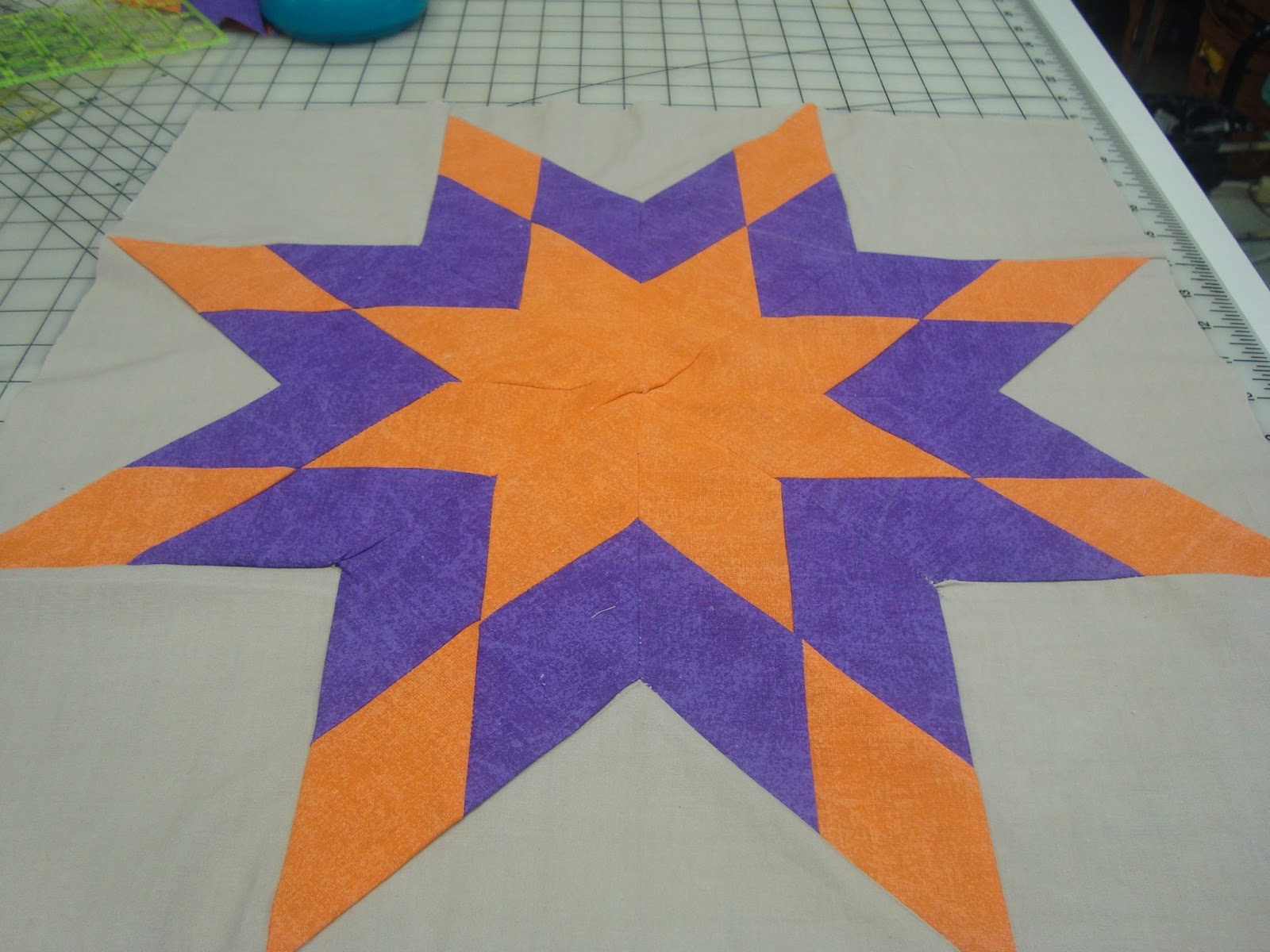
I really struggled grasping y seams with the June block on Block of the Month 2013. I haven't done a Lemoyne star before so I was excited to begin. Then it came to doing it, not so much.
We joined two strips at 2 1/2 wide together. That was easy enough. Then it came to cutting the forty five degree angles and the troubles began. I am new to doing angles most of my work is with squares and half squares until recently where I have learned some new techniques. That is why I did take classes on Craftsy to help me learn new blocks and get some great tips along the way.
I messed up the first cuts because I did put the 45 degree line in the right place before I cut. I watched that part of the video and went back to it again. Then it came to the assembling, I found marking the lines on the cloth so I knew where to stop was really important in making the block work. I also noticed that my 1/4 inch mark did not match my 1/4 foot on my machine. I didn't know that. I double checked my marking on the cloth and then the machine. I found the foot was definitely wider than it was supposed to be. So that might explain why on several other blocks I had trouble.
Well I did finally get it but not before taking it apart five times in different places. I made two new sections because of the bias. I have this bin I am filling for a crazy quilt so in there they went.
This was the block after all the frustration.

This is what my halfway point looks like on the 2013 Craftsy Block of the Month The colors are working out very well on the beige.
 
While I was on a roll I started adding the 2 1/2 inch strips to my 2012 Craftsy Block of the Month quilt so I can begin the machine quilting class with Leah Day. I went back and forth on whether I would do it with black or white. I finally tossed a quarter and white one. Once I had the white I really found the color enhanced my blocks the way I wanted the sashing to do. I am posting several of the blocks so you can see what I mean. I think white makes the blocks pop.
 
I really like the way the white sets this block.


                                               The white here connects the block.


Here it also connects the block.

This block without the white border I really did not like but with the white it works.

Unfortunately this block I still don't like the colors but I do not have enough blue to do another one.

This block is more visual with the white. It was mundane before.
It's funny Amy Gibson of http://www.stitcherydickorydock.com
used the Kona white in her quilt for class and that is the color my borders are making the blocks stand out the way I want.
 
We had these crazy thunder storms on Thursday that made the power flicker during its tirade. Friday morning Purryl kept pacing downstairs on the lower patio area so I went to see what was bothering her. One of my hanging planters had come down in the crazy wind and rain. Unfortunately the hanging planter was filled with impatiens, petunias and vinca. Underneath where it hung were two clay pots with green beans in them. They did not survive the crash. The pots were shattered and the bean plants have several broken branches. I transplanted but not sure if they will survive. The impatiens, petunias and vinca faired much better I replanted them in their plant dish. The hanger though was not salvageable. They just don't make rugged hangers like they used to. Everything seems to be made in China. :(
 
I'm reading this fascinating book called Moonwalking with Einstein. by Joshua Foer. I am enjoying it more than I expected. Originally, I bought it with the intent to improve my memory. Like a lot of self help books you read because you need too but this also quite informative as well as entertaining. 


Wednesday, June 26, 2013

My first Tunisian project

I am very pleased to say I have completed the Honeycomb scarf that was the project I was introduced to on Anny's com. It took several days and a lot of pulling out a row until I finally stopped dropping stitches but I did finally wrap my head around the technique. It does make a denser feeling scarf with a very attractive pattern.
this is a close up with my work in progress.

just showing how dense the stitches appear
 

My finished scarf. It took exactly 7 ounces of yarn, but you can wrap it around your neck and tuck it into your winter coat. This scarf took me over 15 hours but mainly because in the beginning I just could not get it right. I can't wait to try my next project. I am sure it will not take as long.

 
This is what I was saying about the pattern it creates as you go. The pattern is simply one of each.
Simple Tunisian stitch and then Tunisian Purl which makes the pattern you see above.
 
In addition to learning how to do the Tunisian stitches I have made some hats and another scarf this year. I take my crocheting in the car with me because I can't look out the window for any extended period of time my vertigo goes crazy and my headaches spike.
The good thing about crocheting for me is that it is more of a feel thing for me than a look at all the time thing. I really don't have to stare at my work, I can tell with the touch of my fingers if the stitch is right.
 
These are some of the projects I have done this year. The hats only take me about 3 1/2 hours from start to finish.

This is the group that I was mentioning in the above commentary.

This one I made to match the set I made my granddaughter Olyvia and my daughter Amanda. Yes, Olyvia's name is spelled this way. Her parents wanted it different. This from start to finish 3 hours using a simple post stitch.

This one matches the set I gave my dear friend Lael and her daughter Braylie. I put flowers on theirs but I did not on this one.

This is a shell stitch beanie I made to go with my scarf in the above picture. From start to finish this hat takes about five hours. I also made each one  for my granddaughters Mikhayla and Caitlyn as well for Mikhayla's friend Emily. Mik's is navy blue, Cait's is hot pink and Emily's is royal purple.
Mik's mom wanted her name spelled uniquely too!

This last one I made for me because I love blue and green together. It is in the fine sport yarn and works really well for spring time or a cooler summer evening.
 
Crocheting is very relaxing and is definitely a take a long project unless you are tackling something like an afghan.
 
Today, I did finally get the impatiens I bought on Saturday in to the ground actually in the knick of time. The sky was gray but not dark so I figured I had plenty of time to trim the carnations back not that they are past their spring bloom. And still have time to get the impatiens planted. I had them all in the ground and was giving them a drink of water. When it began lightning, so I took the hose back to the garage and started rolling it back on to the wall bracket when the sky let loose. If I had lingered a minute I would have been soaked to the skin. It was only a matter of seconds between the time I stepped into the garage and the rain began. Phew!